Tithe Barn Skipton


The Story of the Tithe Barn Skipton
Introduction
Nestled just outside the town of Skipton in North Yorkshire lies the historic Tithe Barn, Skipton. This storied building — once used as a barn for the collection of tithes — offers a fascinating glimpse into local agricultural and ecclesiastical history. In this article, we’ll explore the origins of the Tithe Barn Skipton, how it has changed over time, its architectural significance, and what it represents today.
Historical Background
- The Tithe Barn Skipton is located at Stirton Lane, Stirton, Skipton, North Yorkshire, BD23 3LN. (historicengland.org.uk)
- The barn was originally used for collecting tithes — a traditional “tax” of one-tenth of a farmer’s produce owed to the church — to support the vicar of the parish. (britishlistedbuildings.co.uk)
- Architectural and documentary evidence suggest the building was constructed in the 17th century (C17). (historicengland.org.uk)
- However, the roof structure preserves elements from an earlier timber-framed building, possibly dating back to the early 17th century or a bit earlier. (historicengland.org.uk)
- In 1774, the Enclosure Act for Skipton awarded the vicar various parcels of land in lieu of tithes. As a result, the barn’s function changed: it was converted into a more general-purpose agricultural barn, with modifications like a threshing floor, a winnowing door, and enlarged cart entrance. (historicengland.org.uk)
Architecture & Structure
The Tithe Barn Skipton is protected as a Grade II listed building — a designation given to structures of special architectural or historical interest. (historicengland.org.uk)
Some of its notable architectural features:
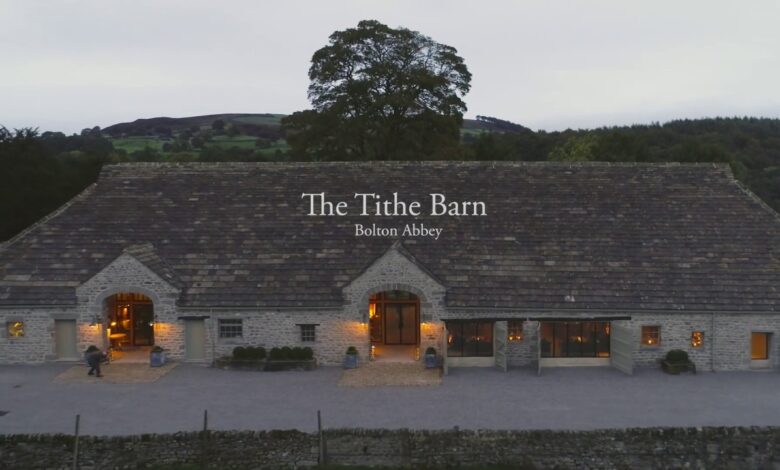
- Built of mixed rubble stone, mainly local silt and mudstone, with some red sandstone, and covered by a stone-slate roof. (britishlistedbuildings.co.uk)
- The plan is a single-cell, five-bay barn. (historicengland.org.uk)
- On the west side is a central cart entrance with a timber lintel made from re-used oak beams — these beams retain original mortise and peg holes and hinge sockets. (britishlistedbuildings.co.uk)
- Internally, the roof structure remains traditional: hardwood (probably oak) rafters and purlins, pegged and jointed — many reused from older timber-framed constructions. (historicengland.org.uk)
- Evidence of later repairs and modifications: in the late 18th century, changes for agricultural reuse; in the 1990s, rebuilding of the southern gable wall with internal breeze-block skin. (britishlistedbuildings.co.uk)
Changing Roles Over Time
Originally meant to store tithes for the church, the barn’s purpose evolved as social and economic systems changed:
- Post-1774, after tithes were replaced by land grants, the barn was no longer needed solely for tithe storage. It was adapted for general agricultural use — storing crops, threshing, and later even housing livestock when part of it was converted into a shippon (cow shed). (historicengland.org.uk)
- Over the centuries, the building saw repairs and modifications to adapt to changing needs: insertion of a winnowing door, enlargement of entrances, closure of ventilation slots, insertion of windows — reflecting its transformation from medieval tithe storehouse to a practical farm barn. (historicengland.org.uk)
- More recently, the barn appears on registries as a heritage building — its historical and architectural value recognized. (historicengland.org.uk)
The Tithe Barn Skipton Today
- The official heritage listing of the barn, under the national registry for protected buildings, ensures its preservation and acknowledges its significance. (historicengland.org.uk)
- While it is not generally open to the public like a museum, its listing status helps protect its structure and appearance — giving interested visitors and heritage-lovers a point of reference when exploring the Skipton area and the nearby countryside.
- Its location — within reach of Skipton town — links it to other historic attractions in the region, such as Skipton Castle and the rural landscapes of the Yorkshire Dales, offering a layered view of rural and ecclesiastical history alongside natural beauty. (tithebarnskipton.co.uk)
Why the Tithe Barn Skipton Matters
- The barn is a physical reminder of how life was organised in rural England centuries ago — the tithe system, parish obligations, and the role of the Church in agricultural communities.
- Architecturally, it retains features that reflect traditional building methods (timber framing, stonework, reuse of materials), offering insight into vernacular craftsmanship and rural building practices of the 17th century.
- Historically, the transition of the barn’s use — from tithe storehouse to general farm barn — reflects changes in land use, economy, and social systems over time (especially after the Enclosure Acts).
- From a heritage perspective, it stands as a protected building that helps contemporary society recall and respect rural heritage, even if it no longer functions as originally intended.
How It Fits into Skipton’s Heritage Landscape
Skipton is well known for its medieval heritage — especially Skipton Castle, which dates back to 1090. (Wikipedia) The Tithe Barn Skipton, though less famous, complements that heritage by representing everyday life: the agrarian society that supported the castle, the Church, and the local communities. Its rustic, sturdy architecture contrasts with the grandeur of the castle, but together they portray a fuller picture of historical life in Skipton.
Conclusion
The Tithe Barn Skipton may not be the grandest building in North Yorkshire — but its quiet presence speaks volumes about rural history, ecclesiastical traditions, and evolving land use over centuries. From its origins as a tithe collection barn in the 17th century, through adaptation for general farming, to its recognition today as a listed heritage building, it offers a layered narrative. If you ever find yourself in Skipton or exploring the Yorkshire Dales countryside, it’s worth remembering that sometimes the humblest barns carry the richest history.
FAQ About the Tithe Barn Skipton
1. What is the Tithe Barn Skipton?
The Tithe Barn Skipton is a historic 17th-century barn located near the town of Skipton in North Yorkshire. It was originally used for storing “tithes,” which were farm goods given to the church as payment.
2. Where is the Tithe Barn Skipton located?
The barn stands on Stirton Lane, Stirton, near Skipton, North Yorkshire. It sits just outside the main town, close to scenic countryside paths.
3. Why is it called a “tithe” barn?
It is called a tithe barn because it was built for collecting and storing tithes — usually one-tenth of a farmer’s produce, given to support the local church or vicar.
4. How old is the Tithe Barn Skipton?
Most of the structure dates to the 17th century, although parts of the roof use even older reused timber. This makes it several hundred years old.
5. Is the Tithe Barn Skipton a listed building?
Yes. It is a Grade II listed building, meaning it is protected because of its special architectural and historical importance.
6. Can visitors go inside the Tithe Barn Skipton?
The Tithe Barn Skipton is not generally open as a public museum. However, the exterior can be viewed, and its listing helps ensure its preservation for future generations.
7. What is special about the barn’s architecture?
The barn features:
- Traditional stone walls
- A stone-slate roof
- A large cart entrance
- Timber beams reused from an earlier building
Its structure reflects the practical, rural building style of the 1600s.
8. What was the barn used for after tithes ended?
After the 1774 Enclosure Act, tithes were replaced by land payments, so the barn no longer stored church produce. It was converted into a general farm barn, used for storing crops, threshing, and even livestock.
9. Why is the Tithe Barn Skipton historically important?
It provides a rare glimpse into everyday rural life from centuries ago — showing how farming, religion, and local communities were connected. Its survival helps historians understand agricultural practices and building methods of the time.
10. Is the Tithe Barn Skipton near other attractions?
Yes. It is close to several Skipton landmarks, including Skipton Castle, the Leeds–Liverpool Canal, and the beautiful Yorkshire Dales countryside.