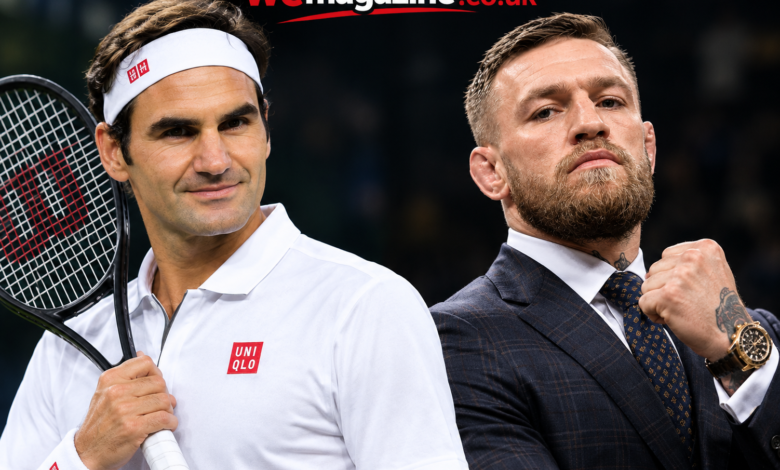
Roger Federer and Conor McGregor
Introduction
Roger Federer and Conor McGregor come from completely different sporting worlds, yet both became internationally recognised names whose influence extended far beyond their respective competitions. Federer established himself as one of tennis’s most accomplished players, combining technical precision, consistency and longevity across a career spanning more than two decades. McGregor, meanwhile, became one of mixed martial arts’ most recognisable figures through championship success, striking ability and an unusually strong public persona.
Although Roger Federer and Conor McGregor never competed against each other, examining their careers offers an interesting look at two very different routes to sporting fame. Federer built his reputation largely through sustained excellence on the tennis court, while McGregor’s rise was characterised by rapid championship success and a powerful ability to attract worldwide attention.
Roger Federer’s Remarkable Tennis Career
From Basel to the Top of Tennis
Born in Basel, Switzerland, Roger Federer developed into a professional tennis player during the late 1990s. His career eventually transformed the expectations surrounding modern men’s tennis.
Federer won 20 Grand Slam singles titles and 103 ATP singles titles. His Grand Slam collection included eight Wimbledon championships, six Australian Open titles, five US Open titles and one Roland-Garros victory. He also reached the world number-one ranking and spent 310 weeks at the top of the ATP rankings.
A Career Built on Technique and Adaptability
One of Federer’s most distinctive qualities was his ability to adapt his game to different surfaces and opponents. His one-handed backhand, precise serve, exceptional movement and attacking style became important parts of his identity.
His success was not limited to one tournament or one period. Federer won major championships on hard courts, grass and clay, demonstrating the versatility required to remain competitive across the tennis calendar.
Wimbledon and Grand Slam Success
Wimbledon became particularly important to Federer’s legacy. He won the prestigious grass-court tournament eight times, including five consecutive championships from 2003 to 2007. His victory at the 2009 French Open also completed his career Grand Slam.
Federer retired from professional tennis in 2022 after a 24-year professional career. His official profile records 20 Grand Slam championships and 103 singles titles.
Conor McGregor’s Rise in Mixed Martial Arts
From Dublin to the UFC
Conor McGregor’s journey followed a very different route. Born in Dublin, Ireland, McGregor began professional mixed martial arts competition in 2008 and eventually entered the UFC in 2013.
His rise was remarkably fast. He defeated a series of opponents before capturing the interim UFC Featherweight Championship in 2015. Later that year, he defeated José Aldo by first-round knockout in just 13 seconds to become the undisputed UFC Featherweight Champion.
Making UFC History
McGregor’s most significant achievement came in 2016 when he defeated Eddie Alvarez to win the UFC Lightweight Championship. This made him the first fighter in UFC history to hold championships in two weight divisions simultaneously.
His career also included notable contests against Nate Diaz, Dustin Poirier, Khabib Nurmagomedov and Donald Cerrone. McGregor later entered professional boxing, facing Floyd Mayweather Jr. in a highly publicised 2017 bout.
The Power of a Distinctive Personality
McGregor’s influence cannot be explained only through his fight record. His confidence, promotional ability and willingness to create dramatic narratives around fights helped make MMA events major entertainment occasions.
The UFC describes him as a former Featherweight and Lightweight Champion and notes his record of 19 wins by knockout and one by submission.
Roger Federer and Conor McGregor: Two Different Paths to Fame
Precision Versus Explosiveness
Federer and McGregor represent contrasting approaches to professional sport.
Federer’s career was based on repeated performance over many seasons. Tennis requires players to manage tournaments, surfaces, opponents and physical demands over a long calendar. Success therefore depends heavily on consistency.
McGregor’s sport operates differently. MMA fighters prepare for individual bouts, often spending months developing specific strategies for a particular opponent. A single moment can dramatically change the outcome of a fight.
These differences make direct statistical comparisons inappropriate. A Grand Slam tennis championship and a UFC title represent achievements within very different competitive systems.
Longevity and Peak Moments
Federer’s career is particularly associated with longevity. He remained a leading figure in tennis for many years and accumulated more than 1,200 match victories during his professional singles career. He also became the oldest player to hold the ATP world number-one ranking when he returned to the position in 2018 at the age of 36 years and 320 days.
McGregor’s career, by comparison, contains several highly memorable peak moments. His 13-second victory over José Aldo and his simultaneous championship status in two UFC divisions became defining moments in UFC history.
Their Influence Beyond Sport
Federer and Philanthropy
Federer’s influence continued after his playing career. Through the Roger Federer Foundation, he has supported educational initiatives, particularly those focused on early and foundational learning in Southern Africa and Switzerland. His post-playing career has also included involvement with tennis and other professional projects.
His public image has traditionally been closely associated with professionalism, elegance and long-term sporting achievement.
McGregor and Entrepreneurship
McGregor has taken a different approach to life outside competition. His public profile has been connected with business ventures, entertainment and commercial activities.
His official biography describes him as a multi-weight UFC champion, entrepreneur and business figure. It also highlights his transition from a plumbing apprenticeship and amateur fighting towards international sporting fame.
This illustrates how elite athletes can turn sporting recognition into wider commercial opportunities.
What Makes Their Careers Interesting?
The Importance of Mental Strength
Mental preparation is essential in both tennis and MMA, although it appears in different forms.
Federer regularly faced long matches in which concentration had to remain high for several hours. A player can recover from one poor point but must continue making accurate decisions throughout an entire match.
McGregor’s environment is different. Fighters have to cope with physical danger, tactical uncertainty and intense psychological pressure. Preparation involves understanding an opponent’s strengths, weaknesses, timing and tendencies.
In both cases, elite performance requires discipline as well as natural ability.
Building a Global Personal Brand
Both athletes also demonstrate the growing importance of personal branding in modern sport.
Federer’s name became associated with premium tennis, international tournaments and a polished public image. McGregor developed a much more outspoken persona, using interviews, promotional appearances and social media to build a distinctive identity.
Their methods were different, but both became recognisable beyond regular followers of their sports.
Federer and McGregor in Popular Culture
The names Roger Federer and Conor McGregor continue to attract interest because they represent two distinct forms of sporting celebrity.
Federer is closely connected with tennis history, Grand Slam competition and technical excellence. McGregor is strongly associated with the rapid global growth of MMA, UFC championship competition and sports entertainment.
Neither career can be fully understood simply by counting victories. Their wider influence includes business, philanthropy, media appearances, sponsorships and their ability to attract audiences who may not normally follow every event in their sports.
Lessons From Two Very Different Careers
Commitment to a Chosen Discipline
Federer’s career demonstrates the value of long-term commitment. Remaining at the highest level of tennis for more than two decades required continuous adaptation, physical preparation and dedication.
McGregor’s story demonstrates another route: entering a competitive field, developing a distinctive identity and pursuing opportunities with extraordinary ambition.
Turning Sporting Success Into Lasting Recognition
Both athletes show that sporting success can become part of a much larger public identity.
Federer’s achievements gave him a lasting place in tennis history, while McGregor’s championships and personality helped make him one of MMA’s most recognisable personalities.
Their careers therefore provide useful examples of how sporting achievement, personal identity and public communication can interact.
Conclusion
Roger Federer and Conor McGregor built remarkable careers in sports with fundamentally different rules, demands and traditions. Federer became a tennis champion through extraordinary consistency, versatility and longevity, collecting 20 Grand Slam singles titles and 103 ATP singles titles. McGregor became a UFC champion in two weight divisions and created some of the most memorable moments of his era through his fighting ability and highly distinctive public personality. wemagazine.co.uk
Their stories are not identical, and their achievements should be understood within the context of their respective sports. What connects them is their ability to become much more than competitors: both developed global identities that remained influential beyond the boundaries of the arena and court.
For anyone interested in modern sports history, Roger Federer and Conor McGregor provide two fascinating examples of how talent, preparation, ambition and personal branding can create enduring international recognition.